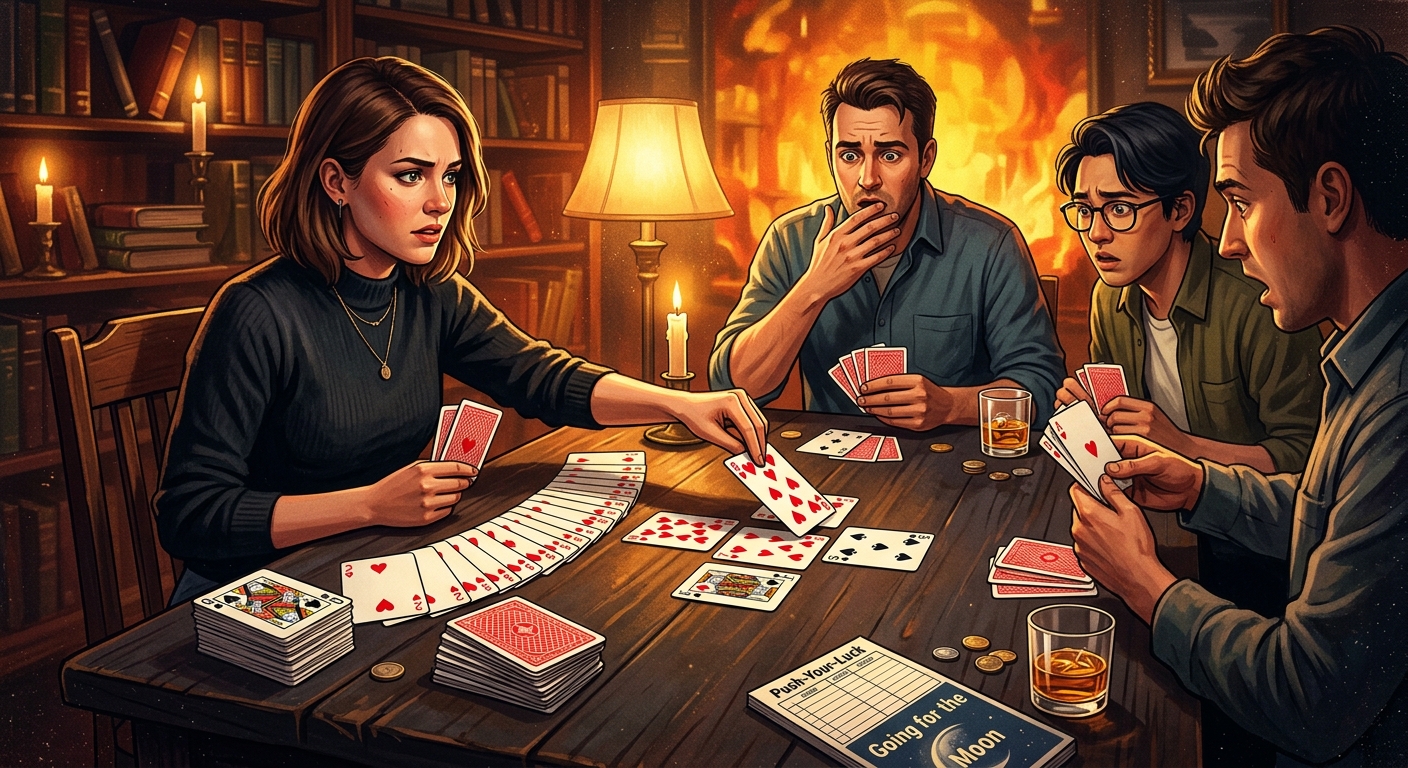
Some decisions in card games feel less like strategy and more like standing at the edge of a cliff, deciding whether to jump. That sensation has a name in game design circles: push your luck. Nowhere in the card world does it hit harder than Hearts, where the biggest swing available, shooting the moon, can flip a losing session into a dominant one. The question is never just "can I do this?" It is "what do I lose if I am wrong?"
Shooting the moon means collecting every heart and the Queen of Spades in one hand, dropping 26 points on every other player. The temptation is real, but so is the danger. This piece breaks down how to read a hand that genuinely has moon potential, how to catch a rival already on that path, and how your card-passing decisions either set that run in motion or shut it down before the first trick is played.
The Same Instinct That Drives Pig Dice
Before getting into Hearts specifics, it helps to see the push-your-luck impulse in its rawest form. Pig dice strips the psychology down to its bones. Each turn you roll, accumulate points, and face the same binary: keep rolling for more, or stop and bank what you have. The mechanics are bare, but the mental tension is identical to what an aggressive Hearts player feels partway through a moon attempt.
In pig, the risk is visible. You can see your running total. You know a single pig roll wipes you out. The probability is fixed and transparent.
Hearts gives you no such clarity. The risk hides inside 51 other cards you cannot see. Your opponents have motives you must infer. And the penalty for a failed moon attempt is not just losing banked points. It is having taken every dangerous card in the deck with nothing to show for it. That asymmetry is what makes moon-shooting such a loaded decision, and why the instincts that serve you in simpler press-your-luck formats need real refinement before they translate here.
What a Threshold Hand Actually Looks Like
Not every hand with a few high cards is a moon-shooting hand. There are specific structural features that separate a hand worth committing to from one that will get you burned at trick seven.
The strongest single indicator is long suit dominance. If you hold six or more cards in one suit, especially spades or hearts, you have a natural mechanism for controlling trick flow. You can lead your long suit repeatedly, deny opponents the chance to void themselves and throw penalties, and keep the trick count moving in your direction.
Second, look at your top-end coverage. Holding the Ace, King, and Queen across multiple suits gives you the ability to win tricks on demand. Moon attempts collapse most often because a player cannot take a trick precisely when they need to. A ten-high hand with good suit distribution is a much harder sell than a hand loaded with aces.
Third, count your void potential. If you are one pass away from being void in a suit you do not control, that void becomes a weapon. You can dump dangerous cards in early tricks before anyone realizes what you are building toward.
A hand worth seriously considering tends to check at least two of these boxes:
- Six or more cards in a single suit with at least two of the top three ranks in that suit
- Aces or Kings spread across three or more suits, giving you trick-taking flexibility
- A natural void or near-void in one low-control suit that arrived before the pass phase
- The Queen of Spades already in hand, removing a major threat variable from the equation
- No isolated mid-range cards (sevens, eights, nines) sitting in suits you cannot control or escape
The more boxes you check before passing, the more confident you can be. A hand that checks only one and a half is not a moon hand. It is a hand that wants to be one, and that is a different thing entirely.
Reading the Table Before You Commit
Committing to a moon attempt without watching your opponents first is like folding a poker hand before checking your cards. The table tells you as much as your hand does, sometimes more.
The most dangerous scenario is another player already building toward the moon. Experienced players recognize the signs early. Watch for an opponent who wins an early trick loaded with hearts and does not flinch. Watch for someone who leads a high card into a suit they probably have no need to establish for avoidance. Watch for a player who takes a penalty card enthusiastically in the first two tricks. These are tells, not certainties, but they shift the math.
If you suspect a rival is running toward the moon, your strategy flips completely. Your job becomes disruption, not aggression. Throwing your lowest hearts early forces them off their line. Taking a trick they were counting on breaks their chain. Bleeding off one key card can collapse the entire attempt.
The critical mistake players make is continuing their own moon attempt while a rival is clearly on the same path. Two players cannot shoot the moon. One will fail. The one who abandons their attempt and disrupts the other consistently gains far more than the one who holds on and finishes second with a hand full of damage.
How Passing Shapes the Entire Attempt
The passing phase is where moon attempts are born and killed. Three cards leave your hand before a single trick is played, and those three cards are not just offload decisions. They are the architecture of the hand you are about to play.
If you are considering a moon run, passing decisions need to serve two goals. First, remove cards that will cost you tricks at the wrong moment. A low heart you cannot control will slip past you in mid-hand and leave a point sitting with someone else. That one missed card ends the attempt. Pass it now rather than cross your fingers.
Second, think carefully about what you are sending and to whom. Passing the Queen of Spades blindly is often defensible when you are going aggressive, because you plan to take everything anyway. But passing it to a player who might use it to disrupt your trick-taking is counterproductive. Think about where danger lands, not just what leaves your hand.
On the receiving end, cards coming your way can either support or collapse a moon plan. If three high hearts arrive in your pass-in, that may be the final confirmation your hand can go the distance. If you receive three low clubs you did not need, reassess immediately. The pass round delivers new information. It is one of the features documented in Hearts game history that most distinguishes the format from simpler trick-avoidance card games, creating a full pre-hand strategic layer before a single card hits the table.
Abandoning the Run Before the Damage Compounds
Knowing when to walk away from a moon attempt is as important as knowing when to start one. Players who cannot let go are the ones who end up carrying 20-plus points in a single hand because they held on two tricks too long.
The clearest signal to bail is a trick you needed that someone else took. If another player scoops a heart-heavy trick you had to win to stay on track, the run is already over. The question is whether you accept that now or pay for denial later.
The second signal is a void exploit that worked against you. You led a suit expecting to win, and an opponent dumped the Queen of Spades or a stack of hearts onto it. That card is now gone from your control. If it was load-bearing to your count, fold. There is no version of the remaining tricks that rescues the attempt.
The cleanest exit from a failed moon attempt is to stop taking tricks entirely. Let the damage consolidate on someone else. Play low cards. Dodge. If you reached trick eight with twelve hearts already in hand and then lost the thread, that is twelve points you carry regardless. Your new goal is making sure everyone else absorbs the remaining fourteen. The hand has changed shape. Change with it.
Knowing the Moon from the Stars
The moon shot in Hearts is one of the game's most electric moments, but it rewards patience and reading ability more than raw aggression. The players who make it land consistently are not the ones who gamble on every strong hand. They are the ones who check hand structure carefully, watch the table for rival signals, use the pass phase as both a scouting tool and a setup mechanism, and abandon the attempt cleanly when the evidence shifts against them.
Push-your-luck thinking is not reckless thinking. The whole point of the instinct is the decision to stop. Knowing your exit is what separates a calculated moon attempt from a costly mistake dressed up as ambition. Bank the points when the hand says bank them, and press hard when the hand genuinely gives you permission to do so. That distinction is the real strategy.